There is something reassuring about having a storage unit. The extra bedroom furniture, the seasonal decorations, the gear you only pull out a few times a year — it all gets a home that is not in your way. But before you start loading boxes, it helps to understand that not everything belongs in a unit, and in a place like Alma, where South Georgia summers arrive early and stay late, that list matters more than it might elsewhere.
Bacon County sits squarely in the wiregrass region of southeastern Georgia, where June through September brings a combination of heat and humidity that is genuinely punishing for certain materials. By the time the community gathers at Goldwasser Park for the annual Georgia Blueberry Festival each summer, temperatures are already pushing into the mid-nineties, and the inside of a non-climate-controlled storage unit can run twenty to thirty degrees hotter than the air outside. That kind of sustained heat transforms what might seem like a harmless decision — stashing that box of old family photos or a collection of vinyl records — into an irreversible one.
The most common damage local customers encounter is the kind that builds quietly over weeks. Wooden furniture swells and warps as moisture cycles in and out of the unit. Photographs and documents yellow, curl, or stick together. Leather goods — a sofa, a coat, dress shoes — lose their natural oils and crack. Electronics are particularly vulnerable; circuit boards and battery components degrade faster than most people realize when they are repeatedly exposed to extreme heat. Musical instruments, especially those with wooden bodies, are similarly at risk. None of this damage announces itself. You open the unit six months later and find something you cannot repair.
If you are storing any of these items for longer than a few weeks through the Alma summer, a climate-controlled unit is worth the conversation. Items that need consistent temperature and humidity levels include fine art and framed prints, wine and other beverages with flavor profiles sensitive to heat, antiques and heirlooms, upholstered furniture that traps moisture, and anything made primarily of leather or natural fabric.
Beyond what the heat can damage, there is a separate and firm category of items that storage facilities universally prohibit — not for the renter's protection alone, but for the safety of everyone storing at the facility.
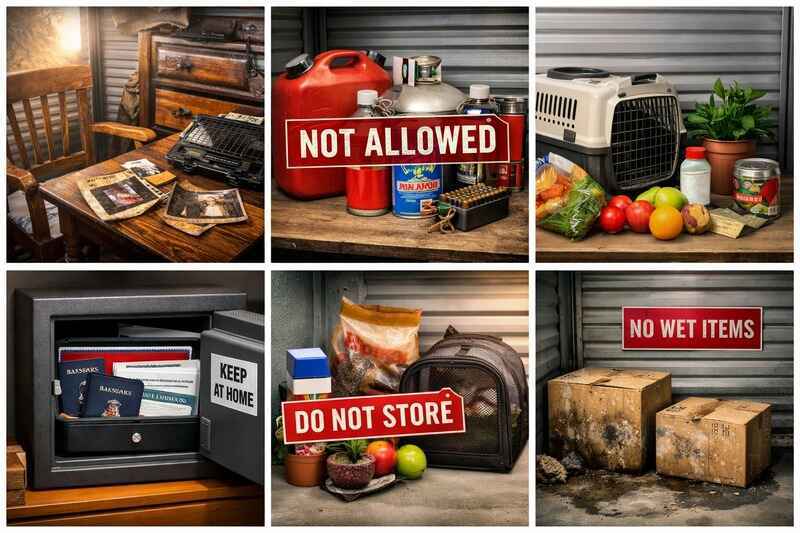
Flammable liquids head this list without exception. Gasoline, propane tanks, kerosene, paint thinner, and motor oil are all prohibited. They are stored under pressure, they react to heat, and in an enclosed unit they pose a fire risk that no responsible facility can permit. Aerosol cans and certain fertilizers fall into this category as well, often to the surprise of customers who consider them ordinary household items.
Ammunition and explosive materials are similarly prohibited at all self-storage facilities, including Alma Affordable Self Storage. So are illegal substances, stolen property, and any materials that emit toxic fumes or can corrode surrounding surfaces if they leak. These restrictions are not arbitrary — they are tied to fire codes, insurance requirements, and the basic obligation a facility has to every renter on the property.
A storage unit is not a pantry, a greenhouse, or a home. Food — including bulk pantry items in unsealed containers — should not go into a standard unit. Even shelf-stable goods can attract insects and rodents when the temperature spikes, and once pests find a way in, the problem rarely stays contained to a single unit. This is worth thinking about year-round in Alma, where the warm climate means pest pressure does not take a winter break the way it might in colder parts of the country.
Plants cannot survive in a sealed, unventilated space, and no living animal should ever be placed in a storage unit under any circumstances. Units are not temperature-regulated for living things and have no airflow adequate to sustain them.
There are a handful of items that are technically not prohibited but are better left out of storage for practical reasons. Original identification documents — birth certificates, Social Security cards, passports — should stay in a fireproof safe at your residence rather than in a unit that you may not visit for weeks at a time. The same applies to irreplaceable family photographs or negatives, which are far better stored at home or digitized than left to the mercy of a South Georgia summer.
Anything that is actively wet or damp should not go into a unit. Mold spores only need moisture and warmth to establish themselves, and Alma has no shortage of either during the long humid stretch from late spring through early fall. Items coming out of a basement, a flooded garage, or a recent move should be thoroughly dried before storage.
Keeping your unit organized and your belongings in good shape is straightforward once you know what to leave out. If you are unsure whether a specific item is allowed, it is always worth a call to the facility before you load the truck. The team at Alma Affordable Self Storage can answer questions about what fits in each unit size and whether the items you have in mind are a good match for the space.
When you are ready to move forward, reserve a storage unit online in just a few minutes. The storage facility is located at 1201 W. 12th Street in Alma, and with units available starting at $45 a month, getting your belongings off your hands and into a safe, monitored space has never been more straightforward.
